Start Here
The meanings given to crystals are traditional beliefs, passed down through ancient legend, folk custom and modern spiritual practice, not properties that science has measured. Every stone also has a mineral side, its chemistry, hardness and color, which gemologists such as those at the Gemological Institute of America (GIA) can describe exactly.
What crystal meanings are
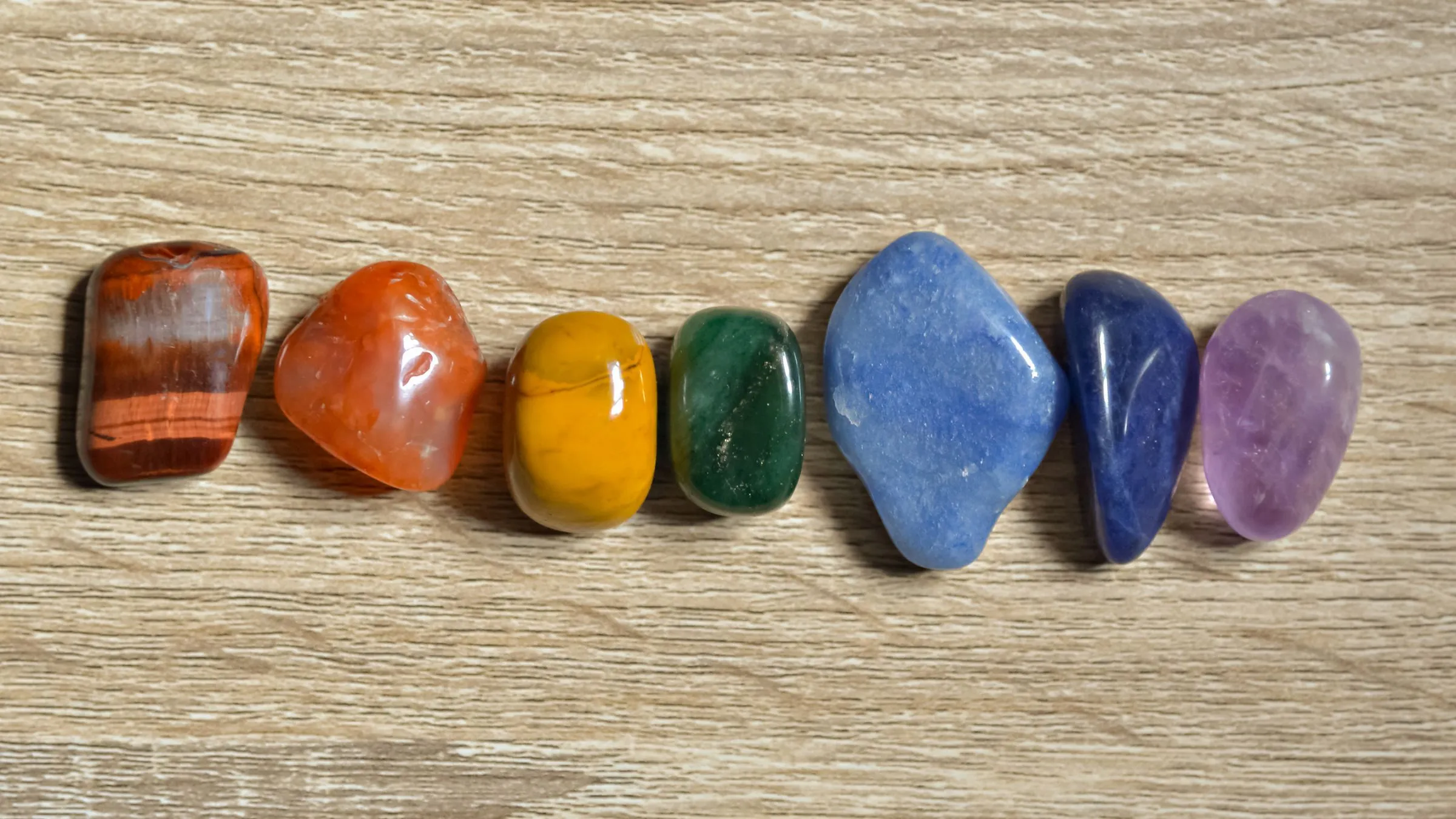
In modern crystal practice, people wear stones on the body or place them under a pillow, with the intention of absorbing positive energy or shedding negative energy. Live Science reports that this practice borrows two older ideas from Asian traditions: the life energy called qi, or chi, and the chakras of Hindu and Buddhist teaching. Practitioners often match stones to seven chakra points on the body, using the colors red through violet.
Practitioners do not all agree. Live Science notes that people who work with crystals hold different ideas about which stones carry which qualities.
Where the traditions come from
People have treasured these stones for thousands of years. GIA traces the link between people and lapis lazuli back more than 6,500 years. Ancient Egyptians used striped agates as talismans, the ancient Greeks carved rock crystal, and Roman pontiffs wore rings set with large amethysts.
Eight stones, their lore and their minerals
Amethyst
The tradition. Early Greek legends tied amethyst, with its wine-like color, to Dionysus, the god of wine. Its name comes from the ancient Greek amethystos, “not drunk,” and wearing it was believed to keep a person sober. Other legends held that it kept the wearer clear-headed and quick-witted in battle and in business. Amethyst has long been set in religious jewelry and appears on bishops’ rings and in the British coronation regalia.
The mineral. Amethyst is the purple variety of quartz, silicon dioxide, with a hardness of 7 on the Mohs scale. It was once as costly as ruby and emerald, until large deposits were found in Brazil in the 19th century. It is the birthstone for February.
Citrine
The tradition. Citrine shares the long history of the quartz family, and Victorian jewelers set it in brooches and pendants. Before modern gemology, its tawny color led people to confuse it with topaz.
The mineral. Citrine is the transparent, pale yellow to brownish orange variety of quartz, colored by a trace of iron. Natural citrine is rare, and GIA notes that most citrine on the market is amethyst that has been heated. In Bolivia, purple and yellow can occur in the same crystal, a gem called ametrine. Citrine shares November’s birthstone with topaz.
Rose quartz
The tradition. In crystal lore, rose quartz is often called the stone of unconditional love. Healthline, reporting this belief, notes there is no scientific evidence that rose quartz offers any health benefit.
The mineral. Rose quartz is named for its pink color, which runs from nearly white to medium-dark. GIA reports that the color comes from microscopic fibers of a silicate mineral similar to dumortierite. Those fibers give the stone its cloudy look, so it is usually cut into beads and rounded cabochons, and a well-oriented cabochon can show a six-rayed star. The finest rough comes from Brazil, with other sources in India, Madagascar and Sri Lanka.
Turquoise
The tradition. Turquoise buried in ancient Egyptian tombs is among the world’s oldest jewelry. The rulers of ancient Egypt wore it, and Egyptians called it mefkat, a word that also means “joy” and “delight.” Chinese artisans carved it more than 3,000 years ago. It is the national gem of Tibet and, in GIA’s words, was long considered a stone of good fortune and protection from evil. For Native American peoples of the Southwest it was a ceremonial gem and a medium of exchange, and the Apache believed that turquoise tied to a bow made a hunter more accurate.
The mineral. Turquoise is a hydrated phosphate of copper and aluminum that forms in dry regions where copper-rich groundwater seeps down through the rock. It is fairly soft, 5 to 6 on the Mohs scale. Its name comes from the French for “Turkish stone.” It is one of the birthstones for December.
Moonstone
The tradition. According to Hindu mythology, moonstone is made of solidified moonbeams. Legends say it brings good luck, and many once believed you could see the future by holding a moonstone in your mouth under a full moon. Art Nouveau designers such as René Lalique and Louis Comfort Tiffany favored it, and New Age jewelers of the 1990s took it up again.
The mineral. Moonstone is a feldspar, a variety of orthoclase. As it forms, it separates into thin alternating layers, and light scattering between them creates the floating glow called adularescence. Its hardness is 6 to 6.5. It is a birthstone for June.
Jade
The tradition. GIA notes that the Chinese associate jade with clarity of mind and purity of spirit, and Chinese jade carving is a tradition more than 3,000 years old. A flat jade disc with a hole in the center, called a bi, symbolizes heaven. Jadeite is also a symbol of prosperity, success and good luck. The Maya and the Aztecs prized jadeite too, and the word jade comes from the Spanish piedra de ijada, “stone of the pain in the side.”
The mineral. Jade is a name for two different minerals, nephrite and jadeite. Neither is unusually hard, at about 6 to 7 on the Mohs scale, but both are extremely tough, and Neolithic knives and axe heads were often made of nephrite.
Lapis lazuli
The tradition. Lapis was treasured in Mesopotamia, Egypt, China, Greece and Rome, and was carved into amulets as well as bowls, game boards and combs. The mines of Badakshan, in present-day Afghanistan, are the oldest known commercial gemstone sources in the world. Renaissance painters used lapis to make ultramarine, an expensive blue pigment.
The mineral. Lapis is a rock rather than a single mineral, made mostly of lazurite, which gives the royal blue, along with calcite and gold-colored flecks of pyrite.
Tourmaline
The tradition. Tourmaline’s history is one of mistaken identity. A Spanish conquistador in Brazil in the 1500s took a green crystal for emerald, and the name comes from the Sinhalese toramalli, “mixed gems,” a term for the many-colored pebbles of Sri Lanka’s gem gravels.
The mineral. Tourmaline has one of the widest color ranges of any gem, from reds and pinks to greens and blues; watermelon tourmaline is green outside and pink inside. It is hard, 7 to 7.5 on the Mohs scale, and it becomes electrically charged when heated or squeezed. It is a birthstone for October.
What research has looked at
Researchers have tested the idea that crystals themselves carry an effect. In a study presented in 2001, the psychologist Christopher French and colleagues asked 80 people to meditate for five minutes holding either a real quartz crystal or a fake one they believed was real. The sensations reported by the two groups were no different. French told Live Science there is no evidence that crystals work beyond a placebo effect, and a Penn State mineral scientist quoted by Live Science says no energy passes between crystals and people. Working with crystals is a personal or spiritual practice, not medical advice.
Frequently asked questions
Are crystal meanings scientific? No. They are traditional beliefs drawn from legend, folk custom and modern spiritual practice. The mineral facts, such as hardness and chemistry, are scientific; the meanings are not.
Why do different books give different meanings for the same stone? Because the tradition is not unified. Live Science notes that practitioners have different ideas about which stones carry which qualities.
Is citrine just heated amethyst? Often. Natural citrine exists but is rare, and GIA says most citrine sold today is amethyst that has been heated.
How hard are these stones? On the Mohs scale, amethyst, citrine and rose quartz sit at 7 and tourmaline slightly higher, while turquoise, at 5 to 6, is softer.
Next steps
Choose one stone and learn both sides of it: the legend and the mineral. Hold it, look at its color and luster, and read where its traditional meaning comes from. If you buy stones, ask the seller what the stone is and whether it has been heated or otherwise altered, since GIA notes that most citrine on the market is heated amethyst. Readers interested in how stones are matched to the body’s energy centers can read about the seven chakras.