Start Here
Reiki is a Japanese spiritual practice in which a practitioner rests their hands lightly on, or just above, a person’s body in a series of set positions. In Reiki practice, the aim is to direct what practitioners call life force energy, or ki, through the hands to the person receiving it.
What Reiki is
The practice took shape in Japan in the early 20th century and has since spread around the world. The name joins two Japanese words. Encyclopaedia Britannica describes rei as a supernatural, universal power or energy, and ki, a word related to the Chinese idea of qi, as the energy found in each living thing. The International Center for Reiki Training reads rei as “God’s Wisdom or the Higher Power” and ki as “life force energy.”
At the center of Reiki teaching is the idea that an unseen life energy flows through every person. Practitioners hold that this energy can be guided through the hands during a session. The center describes Reiki as spiritual in nature but not a religion, with no dogma and nothing a student must believe in order to learn it. Britannica notes that its followers say people of any faith can take part.
Where Reiki comes from
The most widely practiced form is called Usui Reiki, after its founder, Mikao Usui, a Japanese Buddhist lay monk who lived from 1865 to 1926. Reiki’s own founding story, as Reiki associations tell it, says that Usui undertook a weeks-long retreat of meditation and fasting, and that on the 21st day he received a vision of ancient Sanskrit symbols in a cave on Mount Kurama. Britannica dates these events to about 1922, while noting that accounts of the date vary. Mount Kurama is still a pilgrimage site for people who practice Reiki.
Usui went on to train students, some of whom became Reiki masters able to teach others. One of them, a retired naval officer named Chujiro Hayashi, opened a Reiki clinic in Tokyo. Hawayo Takata, a Japanese Hawaiian woman who came to that clinic as a client, brought the practice to Hawaii in 1937. She went on to teach Reiki and train masters across the United States, and she kept practicing and teaching until her death in 1980. The International Center for Reiki Training credits her with bringing Reiki from Japan to the West.
Several years after developing Reiki, Usui added a short set of ethical ideals to the practice. According to the International Center for Reiki Training, they drew in part on five principles of the Meiji emperor, whom Usui admired. In the center’s translation they begin: “Just for today, do not anger. Do not worry and be filled with gratitude. Devote yourself to your work. Be kind to people.” The text of the ideals asks that they be said every morning and evening.
What happens in a Reiki session
A standard session, as Reiki sources describe it, runs like this.
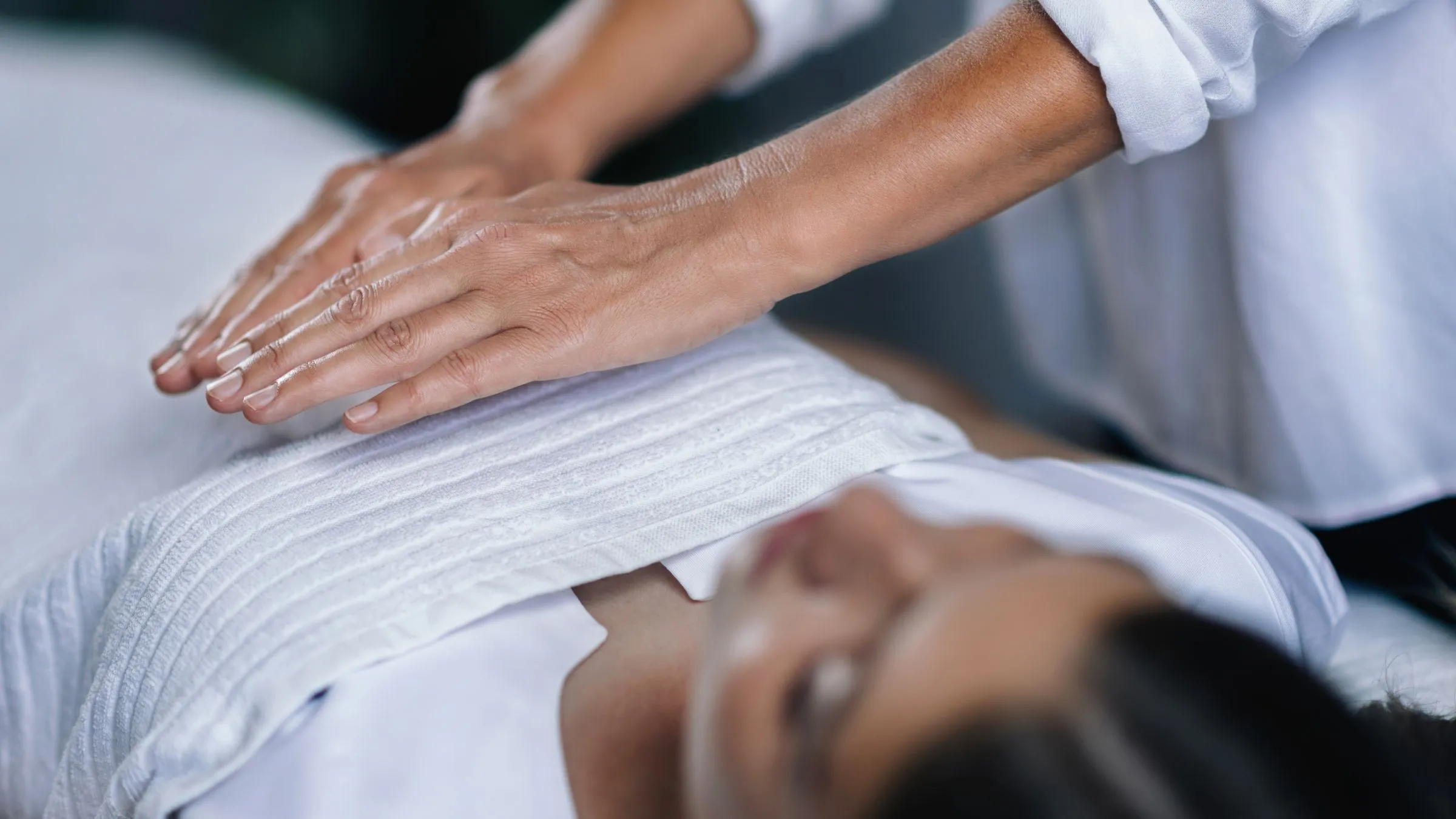
- You stay dressed. The person receiving Reiki remains fully clothed. Most sessions take place lying on a massage table, though Reiki can also be given seated in a chair or even standing.
- The practitioner works through hand positions. The practitioner places their hands on or just above the body in a sequence of positions, usually around the head and shoulders, the stomach and the feet. Britannica describes a series of up to 15 prescribed positions, with others added on request.
- Each position is held for a few minutes. The International Center for Reiki Training says each position is held for three to ten minutes.
- The touch stays light. Unlike massage, Reiki involves no rubbing or pressure. Where the hands touch at all, the contact is light.
- The session ends after about an hour. Reiki sources give session lengths from about 45 to 90 minutes.
People describe what they feel in different ways. Britannica records reports of warmth or tingling and a deep sense of relaxation, and some people fall asleep on the table.
How Reiki is learned
In Reiki teaching, the ability to practice is passed from teacher to student in a step called an attunement, given by a Reiki master during a class. During an attunement the master touches the student’s head, shoulders and hands and uses special breathing techniques. Students first learn to practice on themselves, a step Britannica describes as essential before working with anyone else.
Training comes in levels. The International Center for Reiki Training teaches four: Reiki one, Reiki two, Advanced and Master. Its beginning class runs over a weekend, in one or two days, and the center recommends at least six to seven hours of class time. The center teaches that every Reiki student belongs to a lineage, a line of teachers leading back to the founder; for Usui Reiki, that line leads back to Usui himself. There is no government licensing for Reiki practitioners.
What research has looked at
Researchers have studied Reiki for pain, anxiety and depression. The National Center for Complementary and Integrative Health (NCCIH), part of the US National Institutes of Health, says Reiki has not been clearly shown to be effective for any health-related purpose, that most of the research has not been of high quality, and that the results have been inconsistent. It also says there is no scientific evidence for the energy field that Reiki is thought to work with.
Britannica notes that there are no known harms associated with the practice, and that it is now offered in many hospitals and other mainstream medical settings alongside conventional care. Reiki is not medical advice and not a stand-in for it. The International Center for Reiki Training itself advises anyone with a medical or psychological condition to see a licensed health care professional, and NCCIH encourages people to talk any decisions about their care through with their own health care provider.
Frequently asked questions
Is Reiki a religion? Reiki teachers say no. The International Center for Reiki Training calls it spiritual in nature but not a religion, and says it has no dogma. Britannica notes that its followers say people of any faith can take part.
Do I need to believe in Reiki for a session? The center says there is nothing a student must believe in order to learn and use Reiki. A session asks only that you lie or sit comfortably while the practitioner works.
Is Reiki the same as massage? No. There is no rubbing or kneading, you stay fully clothed, and the practitioner’s hands either rest lightly on the body or hover just above it.
Can Reiki be done on yourself? Yes, after training. Britannica describes self-practice as an essential step that Reiki students take before working on anyone else.
How do I find a Reiki practitioner? With no government licensing, it is worth asking a practitioner or teacher about their training before booking. The International Center for Reiki Training suggests asking prospective teachers and practitioners a few questions first.
Next steps
If you are curious about Reiki, a single session with a practitioner is the simplest way to see what it involves. Ask beforehand which levels they have trained to, who their teacher was, and how long the session will last. If you would like to practice yourself, look for a beginning class, called Reiki one in the center’s system, and ask how many hours it runs and how much time is spent practicing in class. You can also start more simply, by reading the Reiki ideals each morning and evening, as their text asks.