Death in brief
In the Rider-Waite tradition, the Death card stands for endings, change and transition, the close of one phase so that another can begin. Modern readers such as Labyrinthos take it as a card of transformation rather than a literal death, while the reversed card points to resisting a change that is already under way.
Waite wrote that the card shows change, transformation and “passage from lower to higher.” Labyrinthos and Biddy Tarot both describe it as one of the most misunderstood cards in the deck, and both read it as one of the most positive.
The card’s picture
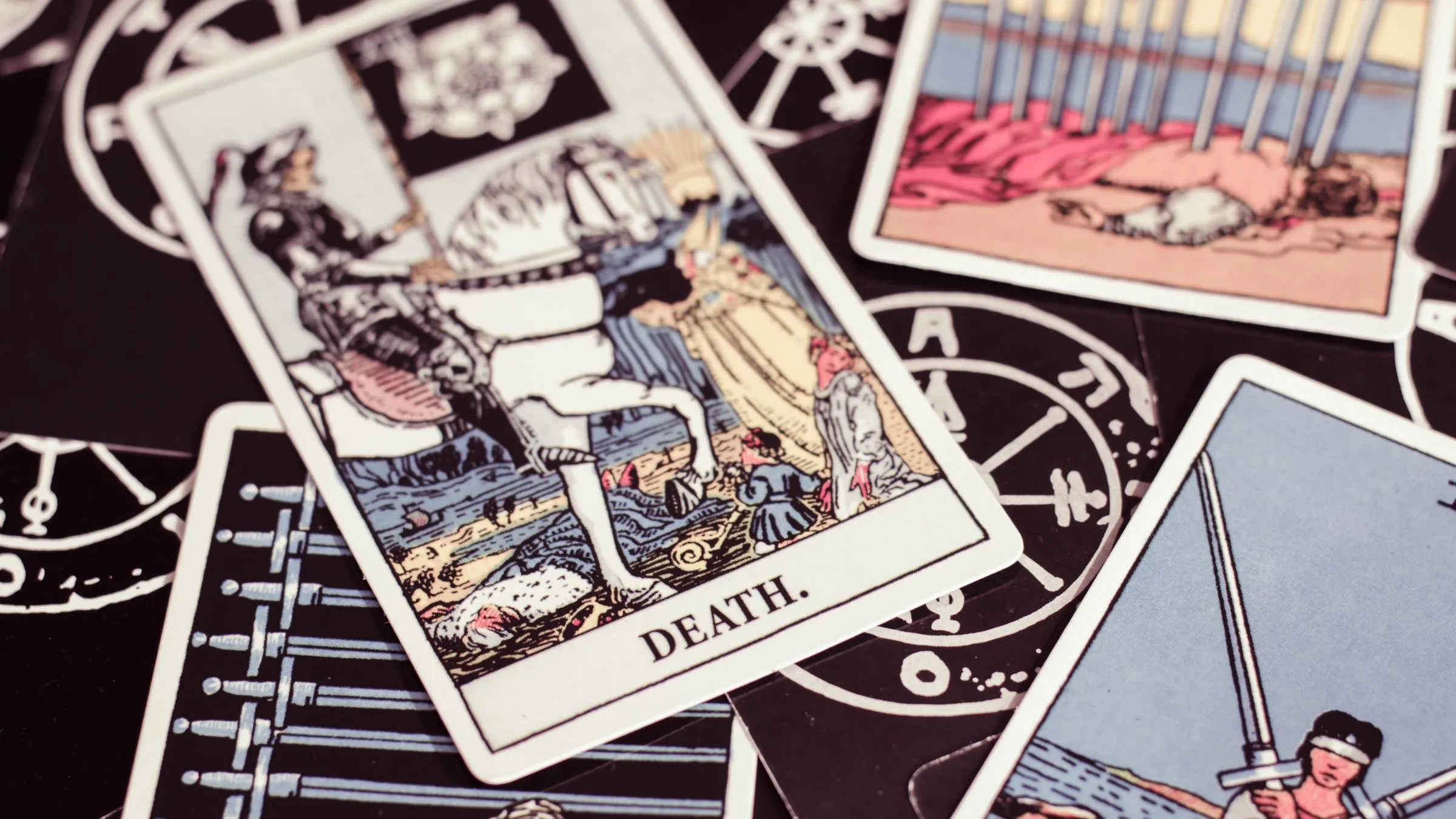
Waite described “the mysterious horseman” moving slowly and bearing a black banner emblazoned with the Mystic Rose, which Waite read as a sign of life. Between two pillars on the edge of the horizon shines what Waite called “the sun of immortality.” Waite noted that the horseman is unarmed, yet a king, a child and a maiden fall before him, while a prelate with clasped hands awaits his end.
Waite chose this image on purpose. He wrote that the idea of change is “more fitly represented” by one of the apocalyptic visions than by “the crude notion of the reaping skeleton” found in older packs. In his notes on those older packs, Waite described the familiar scene of a skeleton with a great scythe mowing heads in a field, and wrote that its alternative meanings were “change and transformation.”
Modern guides read the details in the same light. Biddy Tarot reads the white horse as purity, strength and power, and the five-petal white rose on the black flag as beauty, purification and change. Biddy Tarot reads the sun setting between two towers as something that sets each night and rises each morning. Labyrinthos reads the figures of every rank lying before the rider, a king among them, as a reminder that death treats every class alike.
Upright meaning
Waite’s divinatory list for the upright card begins with “end” and mortality, the plain traditional reading. Waite also wrote that the existing occult explanations of the thirteenth card are “better than usual”: “rebirth, creation, destination, renewal, and the rest.”
Labyrinthos reads the upright Death card as the end of one major phase of life and the start of a new one, closing one door so that another can open. Labyrinthos also reads it as a major change, transition or transformation, and as a call to let go of attachments that no longer help.
Biddy Tarot reads the card, after the pause of The Hanged Man, as the end of a phase that no longer serves, opening room for something more valuable. Biddy Tarot also reads it as a time to clear away the old to bring in the new, and as a good card for breaking a habit or pattern of behavior.
Reversed meaning
Waite listed the reversed card as inertia, sleep, lethargy, petrifaction and somnambulism.
Labyrinthos reads reversed Death as change that is still coming but is being resisted, often from worry about letting go of the past. Labyrinthos also reads it as a sense of being in limbo, and as a prompt to look at how one has been approaching change.
Biddy Tarot reads the reversed card as being on the verge of meaningful change while holding back, leaving life feeling stuck. Biddy Tarot also reads it, on a deeper level, as a personal transformation taking place in private, a release of fears and old habits to make space for the new.
Death in love
In love, Labyrinthos reads the upright Death card as emotional dynamics that are no longer working, where a relationship needs to embrace change to continue. Labyrinthos also reads it as a new era for a couple, and for single people as the shedding of old beliefs and behaviors to make way for stronger relationships.
Reversed, Labyrinthos reads the card as strong resistance to change in relationships, such as holding on to one that has gone stagnant out of comfort or obligation. Labyrinthos also reads the reversed card as a sign that old relationships can be revived.
Death in career
For work, Labyrinthos reads the upright Death card as a sign to act on a career change that has been on the mind. Labyrinthos also reads it as a reminder that clinging to stability in an unfulfilling job can cost more than comfort.
Reversed, Labyrinthos reads the card as resisting a transition at work that is already pressing. Labyrinthos also reads it as old patterns repeating in the workplace, and as a prompt to consider what must be let go.
Death and money
Labyrinthos reads the upright Death card in money questions as a period of change that can transform how a person relates to money and what they value.
Reversed, Labyrinthos reads the card as difficulty accepting and adapting to such a change, and frames it as a prompt to stop resisting it.
Death as feelings
As feelings, Labyrinthos reads the upright Death card as transformation and renewal: someone who senses a connection evolving and old patterns ending. Labyrinthos also reads it as one’s own readiness to shed past baggage and welcome fresh beginnings.
Reversed, Labyrinthos reads resistance to change, with someone feeling stuck and holding on to the past. Labyrinthos also reads the reversed card as one’s own sense of stagnation alongside a wish for renewal.
Questions to reflect on
- Which chapter of life feels as if it is coming to a close?
- What is being held on to out of habit rather than meaning?
- What space could open if something old were released?
- Is a change already under way that is being resisted?