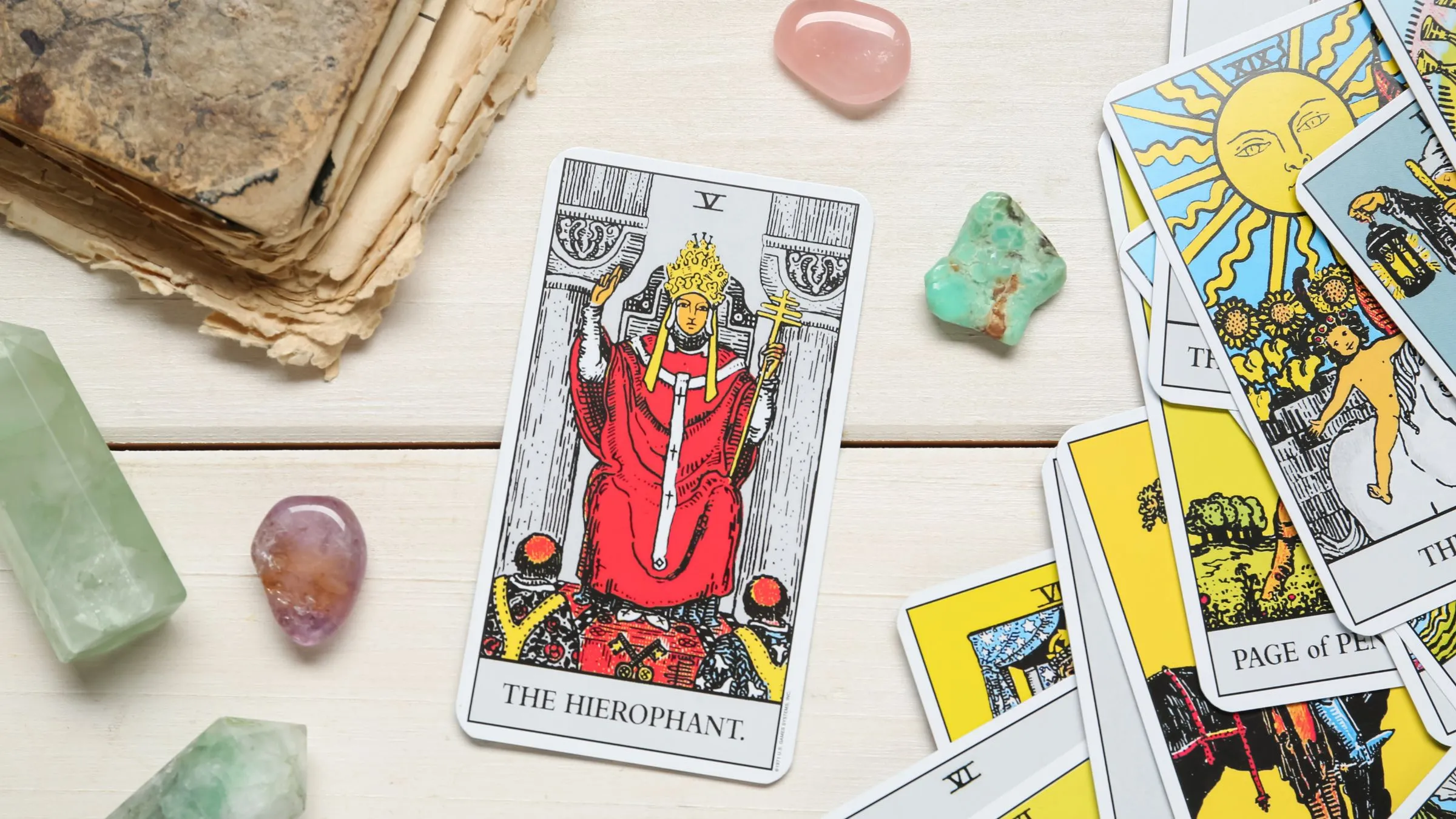
The Hierophant in brief
In the Rider-Waite tradition, The Hierophant stands for tradition, institutions, teaching and shared belief. Modern readers often take it as a call to learn from an established path or a trusted teacher, while the reversed card points to questioning convention and finding one’s own beliefs.
Waite wrote that he has usually been called the Pope, and Biddy Tarot notes he is also known as the Teacher in other decks. Both Waite and Biddy Tarot pair him with The High Priestess as her outward, institutional counterpart.
The card’s picture
Waite described a figure wearing the triple crown, seated between two pillars, though not the pillars of the temple guarded by The High Priestess. In his left hand he holds a scepter ending in the triple cross. With his right hand he gives the ecclesiastical sign that Waite read as distinguishing “between the manifest and concealed part of doctrine.” At his feet lie crossed keys, and two priestly ministers in albs kneel before him.
Waite noted that The High Priestess makes no sign, while The Hierophant does. He called him “the ruling power of external religion” and, quoting Grand Orient with approval, “the power of the keys.”
Modern guides add color to the picture. Biddy Tarot reads his three robes and three-tiered crown as the three worlds he rules over, and the two kneeling followers as a rite of passage and a shared group identity. Biddy Tarot reads the crossed keys as the balance of the conscious and subconscious mind. Labyrinthos reads the two acolytes as the passing on of sacred knowledge within institutions.
Upright meaning
Waite’s divinatory list for the upright Hierophant includes alliance, captivity and servitude, and by another account mercy, goodness and inspiration. Waite also named him “the man to whom the Querent has recourse,” the person one turns to.
Labyrinthos reads the upright card as embracing the conventional, a wish to follow a process that is well established rather than to innovate. Labyrinthos also reads it as institutions and their core values, and sometimes as ceremonies or rituals.
Biddy Tarot reads The Hierophant as an established set of spiritual values and beliefs, and as a call to learn the basic principles from a trusted teacher, mentor or guide before forming one’s own views. Biddy Tarot also reads it as group membership and the comfort of shared values, and as a prompt to honor family traditions or sacred rituals that have been neglected. Biddy Tarot adds that someone who has mastered a field may be taking on the teacher’s role.
Reversed meaning
Waite listed the reversed Hierophant as society, good understanding, concord, overkindness and weakness.
Labyrinthos reads the reversed card as feeling restricted by too many structures and rules, with a strong wish to break free from convention. Labyrinthos sums up the reversal as questioning traditions and making sure that a choice is right for the person making it.
Biddy Tarot reads the reversed Hierophant, in its most positive form, as a reminder that a person is their own teacher, with wisdom coming from within. Biddy Tarot also reads it as challenging the status quo and examining whether “the way things are done” fits one’s values, and notes it can show conflict with an authority figure.
The Hierophant in love
In love, Labyrinthos reads the upright Hierophant as relationships that are traditional, conventional and socially approved, with partners who share a system of beliefs. Labyrinthos also reads it as the more spiritual side of love.
Reversed, Labyrinthos reads the card as a relationship that has become stale, or as values that do not quite align and call for some compromise. Labyrinthos adds that not all advice about a relationship may suit it, and reads the card as a prompt to think for oneself about what works.
The Hierophant in career
For work, Labyrinthos reads the upright Hierophant as success through working with others and staying on a tried and tested path. Labyrinthos also reads it as a senior mentor, and as a time of learning through school or vocational training.
Reversed, Labyrinthos reads the card as creativity and freedom at work stifled by bureaucracy, processes or rules, with pressure to follow decisions one disagrees with. Labyrinthos frames the reversed card as a prompt to weigh whether one can stay true to one’s own views in the current place.
The Hierophant and money
Labyrinthos reads the upright Hierophant in money questions as a mood that favors the traditional and established over the new and unfamiliar.
Reversed, Labyrinthos reads the card as the advice of peers feeling stifling, and an itch to try new ways of earning. Labyrinthos frames the reversed card as a prompt to stay realistic about how much risk feels acceptable.
The Hierophant as feelings
As feelings, Labyrinthos reads the upright Hierophant as respect and admiration: someone who values tradition and stability and sees the connection as meaningful and in line with their beliefs. Labyrinthos also reads it as one’s own wish for deeper understanding and shared values.
Reversed, Labyrinthos reads confusion and a streak of rebellion, with someone questioning norms and their own feelings. Labyrinthos also reads the reversed card as one’s own restlessness with conventional routines and a wish for freedom.
Questions to reflect on
- Which traditions in life still feel meaningful, and which are followed out of habit?
- Who has been a trusted teacher, and what did they pass on?
- Is a current rule or structure helping, or holding something back?
- What beliefs feel truly one’s own?