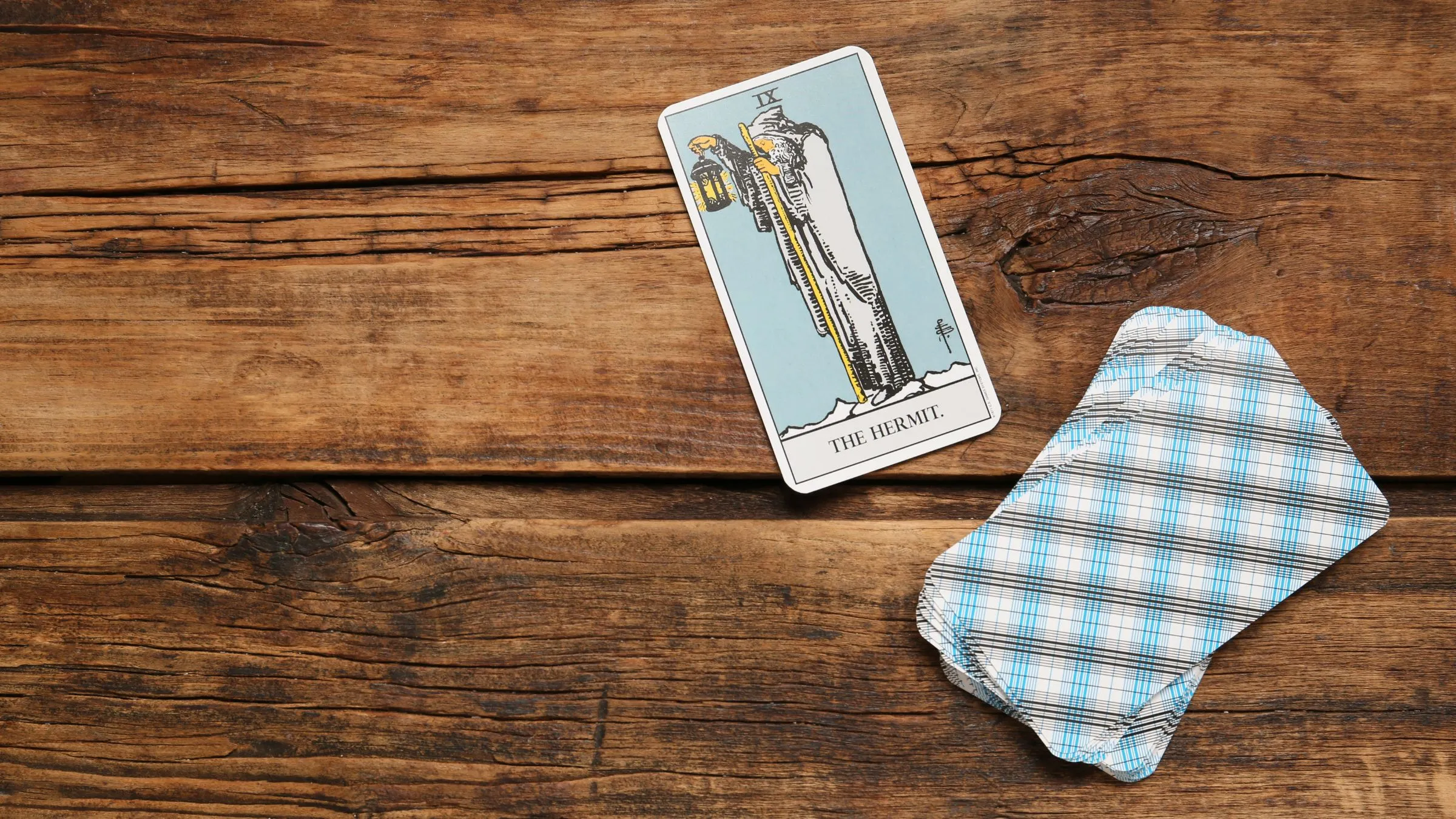
The Hermit in brief
In the Rider-Waite tradition, The Hermit stands for solitude, introspection and the search for guidance from within. Modern readers often take it as a call to step back from the noise of daily life and reflect, while the reversed card points to isolation and loneliness, or to too little time for reflection.
Waite insisted that The Hermit is “a card of attainment” rather than a card of quest. Waite read his raised lantern as a beacon whose message is “where I am, you also may be.”
The card’s picture
Waite described a figure who blends the idea of “the Ancient of Days with the Light of the World.” He holds up his lantern, and Waite wrote that “it is a star which shines in the lantern.” Waite noted that the only change from older designs is that the lamp is no longer partly wrapped in the bearer’s mantle. Waite also placed the figure on a height, holding up his beacon “on an eminence.”
Waite rejected older readings of the card. He wrote that The Hermit is not, as Court de Gebelin explained, a wise man searching for truth and justice, and that linking him to “occult isolation” is a frivolous reading. In his view, the card shows that divine mysteries protect themselves from those who are unprepared.
Modern guides read the details. Biddy Tarot reads the snow-capped peak as spiritual mastery, growth and accomplishment, and the six-pointed star in the lantern as the Seal of Solomon, a symbol of wisdom. Biddy Tarot notes that the lamp lights only the next few steps, not the whole road. Labyrinthos and Biddy Tarot both read his staff as power and authority.
Upright meaning
Waite’s divinatory list for the upright Hermit is prudence and circumspection, and also, as he put it, “especially treason, dissimulation, roguery, corruption.”
Labyrinthos reads the upright Hermit as a seeker of knowledge that comes from within, the inner voice that can only be heard after long solitude. Labyrinthos also reads it as a wish to be alone to clear the mind, and as an effort to act in a way that is true to oneself. Labyrinthos adds that the card can also stand for a mentor.
Biddy Tarot reads The Hermit as taking a break from everyday life to turn inward and find answers deep within. Biddy Tarot also reads it as a pivotal point when a new direction is being considered, with priorities shifting through meditation and self-examination. Biddy Tarot adds that the card can describe turning away from materialism, or a spiritual mentor who teaches others to find their own answers.
Reversed meaning
Waite listed the reversed Hermit as concealment, disguise, policy, fear and unreasoned caution.
Labyrinthos reads the reversed card as seclusion that may become harmful, a person stuck in a world of their own. Labyrinthos frames the reversed card as a call to balance the need for inner truth with connection to other people.
Biddy Tarot reads the reversed Hermit as going one of two ways: too little time for personal reflection, or too much. Biddy Tarot reads the first as a prompt to make more space for reflection, and the second as a warning against cutting oneself off from family and friends.
The Hermit in love
In love, Labyrinthos reads the upright Hermit as time alone to gain insight into oneself before forming a strong relationship. For couples, Labyrinthos reads the card as soul-searching done together about what each person expects from the relationship.
Reversed, Labyrinthos reads the card as loneliness that is imposed rather than chosen, or as one partner feeling distant and drifting away. Biddy Tarot reads the reversed card in relationship readings as unwelcome isolation, with one person wanting space and the other wanting closeness, and sometimes as readiness to reconnect.
The Hermit in career
For work, Labyrinthos reads the upright Hermit as time spent thinking about what is wanted from a career, often with a sense that the current path is not fulfilling. Labyrinthos also reads it as a search for purpose, beyond money or stability alone.
Reversed, Labyrinthos reads the card as coming out of a period of contemplation, ready to rejoin others with a clearer sense of direction. Labyrinthos also reads it as choosing to work alone, or as feeling like an outcast among coworkers.
The Hermit and money
Labyrinthos reads the upright Hermit in money questions as a realization that money alone does not bring happiness, with less focus on material things.
Reversed, Labyrinthos reads the card as readiness to seek outside advice after a period of reflection on what security means.
The Hermit as feelings
As feelings, Labyrinthos reads the upright Hermit as thoughtful, unhurried feelings: someone taking time to reflect on the bond and needing to step back for now. Labyrinthos also reads it as one’s own search within for what matters in the relationship.
Reversed, Labyrinthos reads confusion and isolation, with someone withdrawing rather than speaking openly. Labyrinthos also reads the reversed card as one’s own mix of frustration and concern, and a wish for deeper connection.
Questions to reflect on
- What answer might come with a little quiet and time alone?
- Is solitude restoring energy right now, or turning into isolation?
- What is the next single step, even if the whole road is unclear?
- Who has been a guide, and who might be helped by what has been learned?