The Chariot in brief
In the Rider-Waite tradition, The Chariot stands for willpower, determination and control, the drive that carries a person past obstacles toward a goal. Modern readers often take it as encouragement to act with focus and confidence, while the reversed card points to a loss of direction, scattered effort or force that has turned into aggression.
Waite wrote that the charioteer is “above all things triumph in the mind.” Biddy Tarot links the card to The Lovers before it: decisions made there in line with one’s values are now being put into action.
The card’s picture
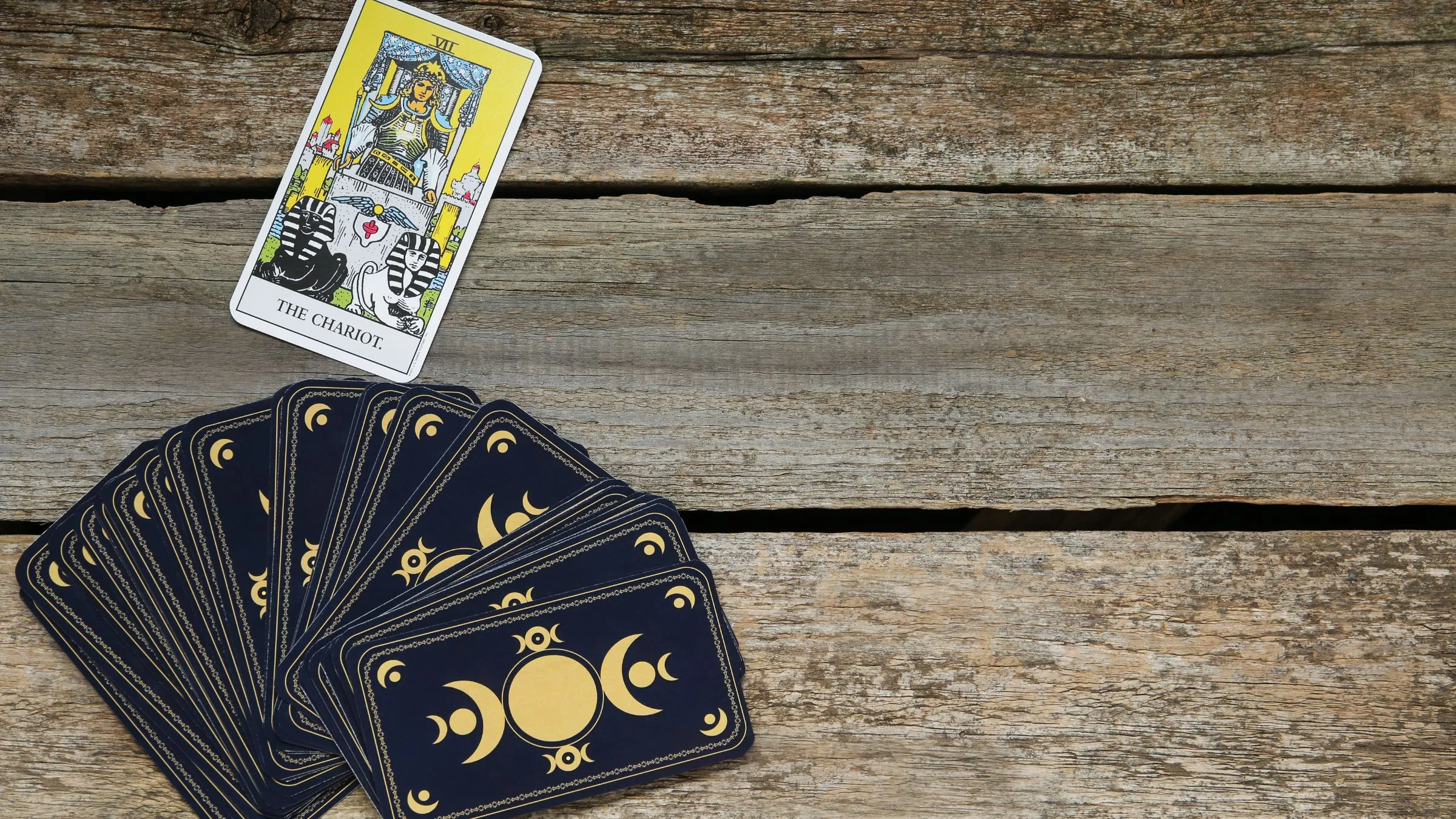
Waite described “an erect and princely figure carrying a drawn sword.” On his shoulders are said to be the Urim and Thummim, and Waite called him “conquest on all planes,” in the mind, in science, in progress and in trials of initiation. Two sphinxes draw his chariot, a variation Waite wrote that he accepted from Eliphas Levi. In his notes on older packs, Waite wrote that the car was once drawn by white horses, and that the card is really “the King in his triumph.”
Waite also set limits on the victory. He wrote that the charioteer’s conquests are outward, not within himself, and that if he stood before The High Priestess he could not open her scroll.
Modern guides describe the scene in more detail. Biddy Tarot reads the crescent moons on his armor as what is coming into being, the square on his tunic as strength of will, and the laurel and star crown as victory. Biddy Tarot notes that he holds no reins and steers by will alone, while the black and white sphinxes pull in opposite directions. Labyrinthos reads the starry canopy above him as a celestial influence and the two sphinxes as opposing forces he must learn to control.
Upright meaning
Waite’s divinatory list for the upright Chariot is succor and providence, and also war, triumph, presumption, vengeance and trouble.
Labyrinthos reads the upright card as overcoming challenges and gaining victory through control, with strength and willpower as the keys. Labyrinthos also reads it as a call to keep focus, confidence and determination through a process full of turns and detours, and to pursue a plan in a structured, ordered way. Labyrinthos notes that competition may bring out an aggressive side, which it reads as useful for taking charge but in need of reining in.
Biddy Tarot reads The Chariot as a card of willpower, determination and strength, and as encouragement to stay on course when pulled in opposite directions. Biddy Tarot also reads it as a call to be bold and courageous, to state desires and set boundaries, and in a literal sense as travel, especially a road trip.
Reversed meaning
Waite listed the reversed Chariot as riot, quarrel, dispute, litigation and defeat.
Labyrinthos reads the reversed card as either a lack of focus, motivation or direction, or an obsession with goals that needs reining in. Labyrinthos also reads it as a reminder that not everything can be controlled, and as a sense of being pulled about by opposing forces.
Biddy Tarot reads the reversed Chariot as a sign to back off or change direction when a push is going nowhere, and to ask what lesson the difficulty holds. Biddy Tarot also reads it as a time for inner work on discipline and commitment before acting, and as a prompt to loosen the grip when trying to control every detail.
The Chariot in love
In love, Labyrinthos reads the upright Chariot as a time to take the wheel, get clear on what is wanted and act on it with confidence and courage. Labyrinthos also reads the card as a need to balance two urges, such as work and a relationship, so that neither suffers.
Reversed, Labyrinthos reads the card as an overwhelming drive to find love that crowds out other goals, and as a reminder that patience matters too. Labyrinthos also reads it as life out of balance, which can sit at the root of disagreements with a partner.
The Chariot in career
For work, Labyrinthos reads the upright Chariot as strong ambition and motivation, with a clear sense of the destination and the discipline to reach it. Labyrinthos also reads it as a card that favors going after a new role or a more senior position, and as advice to stay clear of office politics.
Reversed, Labyrinthos reads the card as either too little ambition and drive or too much, and asks how forceful a person is being in pursuit of goals. Labyrinthos frames the reversed card as a prompt to find a balanced middle ground between passivity and aggression.
The Chariot and money
Labyrinthos reads the upright Chariot in money questions as motivation, focus and determination to deal with obstacles that have stood in the way of stability.
Reversed, Labyrinthos reads the card as rushing into purchases without thinking them through, or, the other way, as hesitating and wavering over decisions.
The Chariot as feelings
As feelings, Labyrinthos reads the upright Chariot as drive and commitment: someone who sees the potential in a connection and is ready to take charge of the challenges. Labyrinthos also reads it as one’s own surge of confidence and motivation.
Reversed, Labyrinthos reads confusion and a lack of direction, with feelings that make it hard to commit or speak clearly. Labyrinthos also reads the reversed card as one’s own loss of control or purpose, and as a prompt to step back and reassess what truly drives a person.
Questions to reflect on
- What goal is worth steady, focused effort right now?
- Which two forces in life are pulling in different directions?
- Is the push forward still working, or is it time to change course?
- Where would loosening control help more than tightening it?