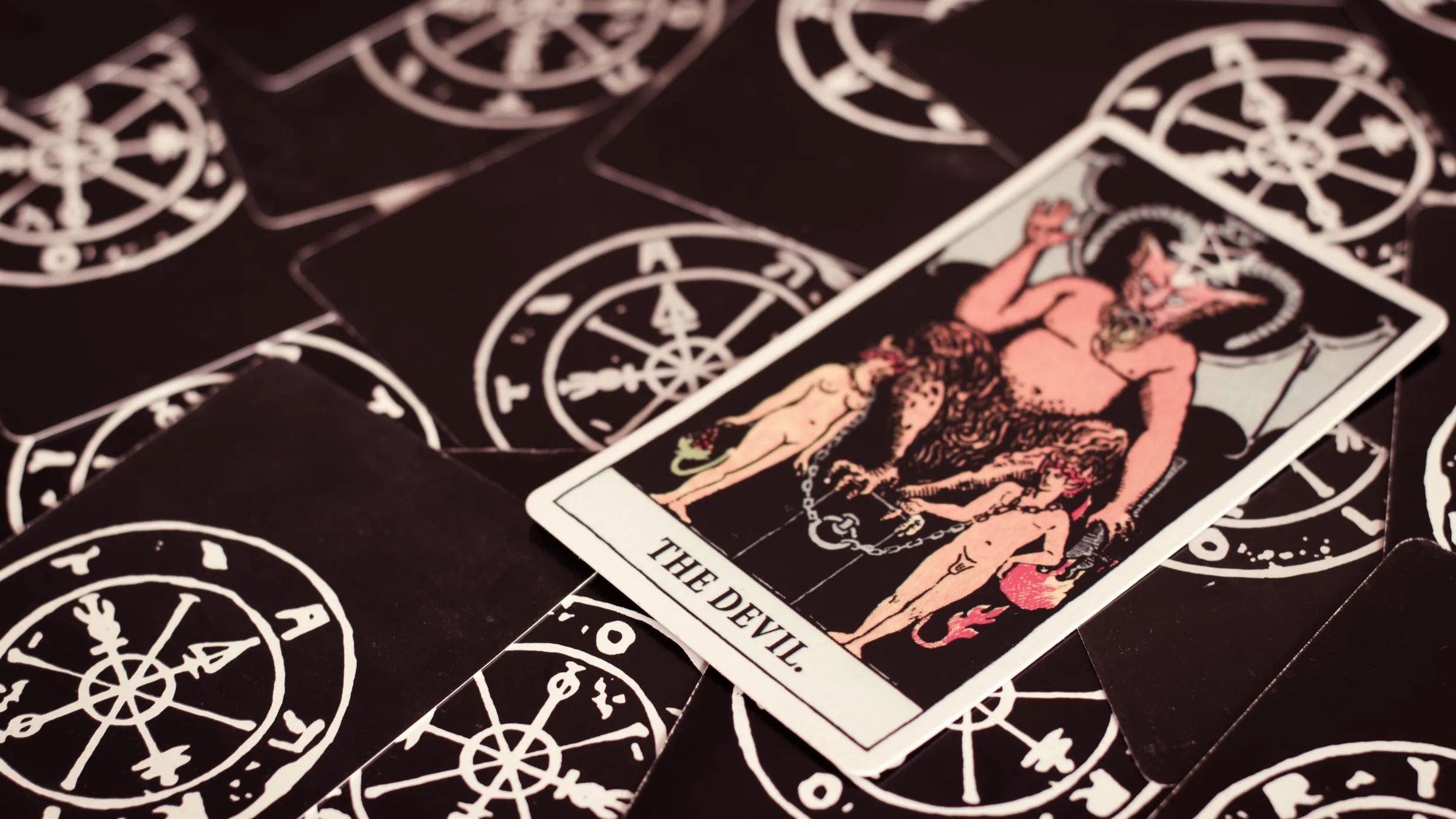
The Devil in brief
In the Rider-Waite tradition, The Devil stands for attachment, temptation and restriction, the habits and desires that keep a person bound. Modern readers often take it as a mirror held up to the shadow side, a call to notice what has a hold and to loosen it, while the reversed card points to release and the reclaiming of personal power.
Waite read the card as “the chain and fatality of the material life.” Biddy Tarot points to a detail in the picture: the chains around the two figures’ necks are loose and could be lifted off.
The card’s picture
Waite described the Horned Goat of Mendes, “with wings like those of a bat,” standing on an altar. At the pit of the stomach is the sign of Mercury. The right hand is raised and extended, which Waite read as the reverse of the blessing given by The Hierophant. In the left hand is a great flaming torch turned down toward the earth, and a reversed pentagram is on the forehead.
A ring in front of the altar holds two chains that run to the necks of a man and a woman. Waite compared them with the two kneeling figures of the fifth card, The Hierophant, and described them “as if Adam and Eve after the Fall.” The figures are tailed, to show the animal nature, but Waite wrote that “there is human intelligence in the faces,” and that the one exalted above them “is not to be their master for ever.” Waite added that even the Devil is “also a bondsman,” sustained by the evil in him.
Modern guides add their own reading. Biddy Tarot reads the bat wings as what happens when raw desires take over, and the small horns on the two figures as a sign that they grow more like the Devil the longer they stay. Labyrinthos reads the flame on the man’s tail and the grapes on the woman’s tail as pulls toward power and toward the finer things in life.
Upright meaning
Waite’s divinatory list for the upright card is ravage, violence, vehemence, extraordinary efforts, force and fatality.
Labyrinthos reads the upright Devil as feelings of entrapment, emptiness and lack of fulfillment, sometimes tied to materialism and a pull toward indulgence. Labyrinthos also reads it as a sense of having no control over one’s actions or urges.
Biddy Tarot reads The Devil as the shadow side and the negative forces that hold a person back, such as habits, dependencies and thought patterns. Biddy Tarot also reads the card as choosing short-term pleasure at the cost of long-term well-being, and as an opportunity to bring these patterns into awareness so their grip can loosen. Biddy Tarot adds that on the positive side the card can describe a powerful attachment between two people, such as a new romance, and can also represent sexuality and one’s wild side.
Reversed meaning
Waite listed the reversed Devil as evil fatality, weakness, pettiness and blindness.
Labyrinthos and Biddy Tarot both read the reversal as release. Labyrinthos reads the reversed card as a moment of self-awareness in which the chains of poor habits are broken, often out of weariness with running in circles. Labyrinthos also notes that breaking such chains is never easy, and reads the card as a call for honest self-assessment.
Biddy Tarot reads the reversed Devil as standing on the edge of a breakthrough, with unhealthy attachments and limiting beliefs to let go of first. Biddy Tarot also reads it as an invitation to practice the Buddhist principle of detachment, releasing dependence on things and people without ceasing to care.
The Devil in love
In love, Labyrinthos reads the upright Devil as lust, temptation and a pursuit of earthly pleasures, with the reminder that honest communication matters. Labyrinthos also reads the card as codependency, which can wear down the individuality of both partners.
Reversed, Labyrinthos reads the card as breaking free from negative emotional patterns and feeling more in control of one’s love life. Labyrinthos also reads it as leaving a domineering or codependent relationship, and as encouragement to keep nurturing independence.
The Devil in career
For work, Labyrinthos reads the upright Devil as feeling stuck or trapped in a job, perhaps blaming circumstances or outside factors. Labyrinthos also reads it as a reminder that there are more choices than it seems, and only one’s own power needs reclaiming.
Reversed, Labyrinthos reads the card as reclaiming accountability for career choices, which can mean leaving a stifling job or repairing a strained working relationship.
The Devil and money
Labyrinthos reads the upright Devil in money questions as habits that make a hard situation harder, and as a sense of being unable to change how money is handled.
Reversed, Labyrinthos reads the card as work under way to change old habits, and as a new sense of independence for anyone who has relied on others.
The Devil as feelings
As feelings, Labyrinthos reads the upright Devil as an intense pull that can border on possessiveness, with desire mixed with insecurity. Labyrinthos also reads it as one’s own struggle with temptation or with feeling trapped in certain patterns.
Reversed, Labyrinthos reads liberation and new clarity, with someone breaking free from old attachments and seeing a relationship with fresh eyes. Labyrinthos also reads the reversed card as one’s own release from self-imposed limits.
Questions to reflect on
- What habit or attachment has more hold than it deserves?
- Where is short-term comfort costing something important?
- Which chains in life are looser than they look?
- What would reclaiming a little personal power look like today?