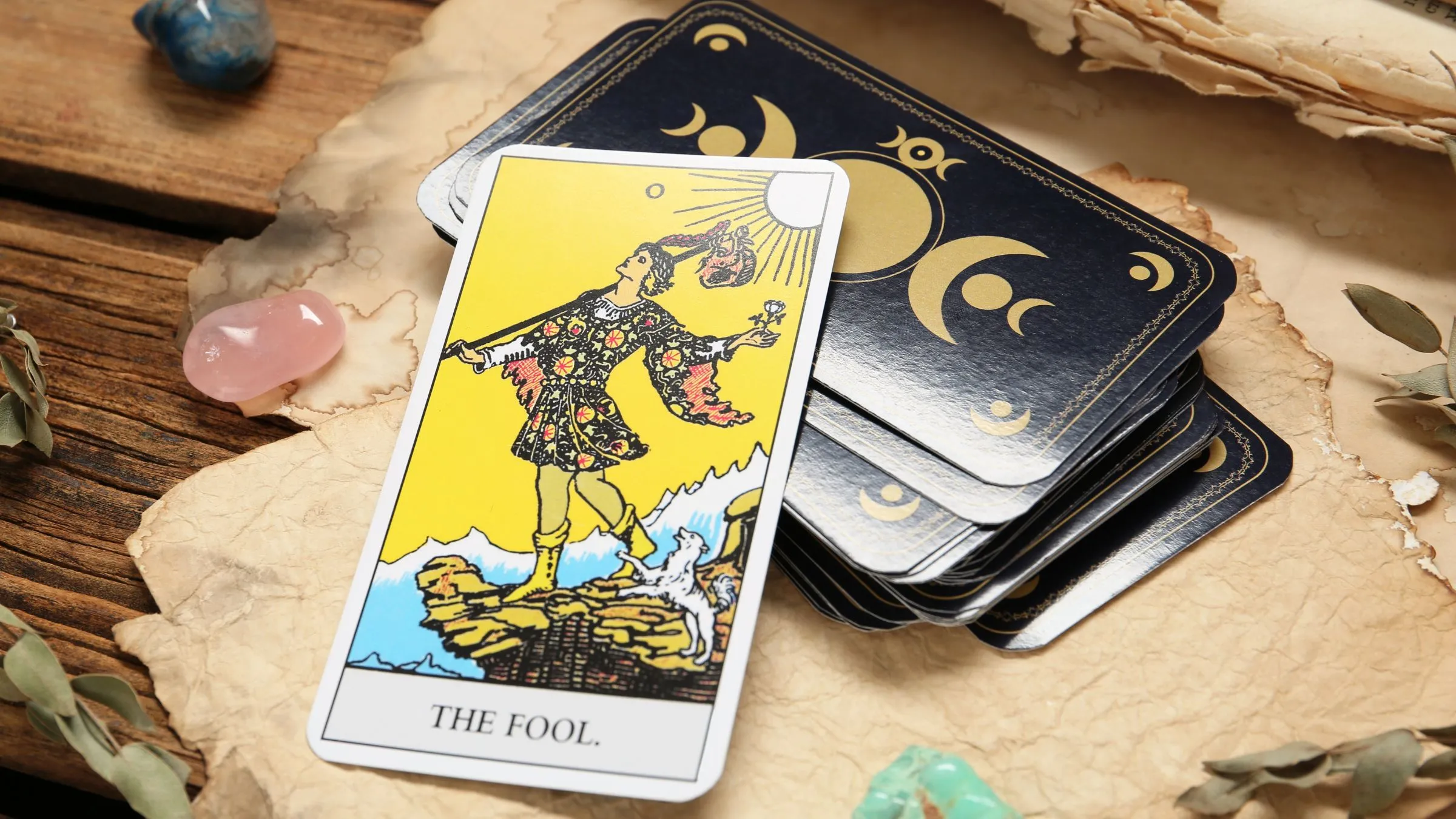
The Fool in brief
In the Rider-Waite tradition, The Fool stands for new beginnings, innocence and a first step into the unknown. Modern readers often take it as a call to trust a fresh start, while its reversed side points to recklessness or to holding back out of fear.
The card carries the number 0, and Biddy Tarot notes that the zero lets The Fool sit at either the beginning or the end of the Major Arcana. Waite himself called the figure “the spirit in search of experience.”
The card’s picture
Waite described a young man in “gorgeous vestments” pausing at the brink of a precipice among the great heights of the world. He looks out at the blue distance and the sky rather than the drop below. He holds a rose in one hand and, in the other, a costly wand with an embroidered wallet hanging from it over his right shoulder. His dog is still bounding, and the sun shines behind him.
Waite wrote that the edge “has no terror” for this traveler, as if angels were waiting to hold him up should he leap. He called him “a prince of the other world” on his travels through this one, his face full of intelligence and expectant dream.
Waite wrote that the Fool as generally understood carries a wallet and looks over his shoulder, unaware of the precipice, while a dog or other animal attacks him from behind. In the Rider-Waite card the figure instead pauses at the edge “with light step.”
Modern guides read the details plainly. Biddy Tarot reads the white rose as purity and innocence, the small white dog as loyalty and protection, and the mountains behind him as challenges still to come.
Upright meaning
Waite’s own divinatory list for The Fool is blunt: folly, mania, extravagance, intoxication, delirium and frenzy. Waite wrote that the Trumps Major “had no place originally” in fortune-telling, and he kept the card’s higher sense, the spirit in search of experience, apart from that list.
Modern readers soften the old list into something closer to Waite’s picture. Labyrinthos reads the upright Fool as the beginning of something new, met with optimism and freedom from the usual constraints of life. Biddy Tarot calls it a card of new beginnings, opportunity and potential, and reads it as a call to follow the heart even when the leap looks foolish from the outside.
Modern readers give the number weight too. Labyrinthos treats zero as a number of infinite potential and describes The Fool as a blank slate whose character is still to be shaped. Labyrinthos also reads the card as a call to the risk-taking part of a person’s character, greeting what lies ahead with joy.
Biddy Tarot reads the card as an invitation to relax, play and treat life with curiosity, like a child again. Biddy Tarot also names it as a card to meditate on in times of dread, worry or self-doubt.
Reversed meaning
Waite listed the reversed Fool as negligence, absence, distribution, carelessness, apathy, nullity and vanity.
Modern readers split the reversal two ways. Biddy Tarot reads it first as holding back: an idea conceived but not yet brought into the world, often out of fear of the unknown or a need to control every outcome. On the other side, Biddy Tarot and Labyrinthos both read it as recklessness, living in the moment with little regard for the consequences.
Labyrinthos points to the dog in the Rider-Waite picture and reads the reversed card as a caution about anything that sounds too good to be true. Biddy Tarot adds a gentler reading, in which the playful spirit of the upright card is simply expressed in a quieter, more private way.
The Fool in love
In love readings, Labyrinthos takes the upright Fool as a sign of new relationships and new experiences, and reads it as advice not to let fear of rejection hold a person back. Labyrinthos sums up the upright card in love as open-eyed innocence and positivity.
Reversed, Labyrinthos reads the card as a call to temper a trusting nature with some caution, especially with a new partner, and to check that a relationship is what it seems. Labyrinthos also reads the reversed card as a sign that one or both people may be too immature for a truly loving relationship right now.
The Fool in career
For work, Labyrinthos reads the upright Fool as a welcome card for anyone thinking about a new career path, a change of job or a venture of their own. Labyrinthos also reads it as fresh air for old projects, with the emphasis on noticing openings and having the courage to take them.
Reversed, Labyrinthos reads the card as plenty of energy with too little insight, and asks the reader to think about how their actions affect colleagues. Labyrinthos also reads the reversed card as a job that feels stale, where any wish for change calls for careful thought first.
The Fool and money
Labyrinthos reads the upright card in money questions as a spontaneous and idealistic mood, with spending drawn toward adventure, travel or learning a new skill. Labyrinthos describes the feeling behind it as a sense of having all that is needed, with less worry about bills.
Reversed, Labyrinthos reads The Fool as carelessness with money, where impulse purchases add up, and as a prompt to take a closer and more realistic look at one’s own habits.
The Fool as feelings
As feelings, Labyrinthos reads the upright Fool as excitement and spontaneity: a person captivated by another’s adventurous spirit and curious about what could begin between them. Labyrinthos also reads it as one’s own desire for freedom and a new chapter.
Reversed, Labyrinthos reads hesitation and uncertainty, with fears or insecurities holding someone back from fully embracing a connection. Labyrinthos frames the reversed card as a prompt to ask what is really standing in the way of joy.
Questions to reflect on
- Where in life is something new asking to begin?
- What would a first step look like if the whole route were not yet clear?
- Is caution protecting something here, or only holding it back?
- Where could a little more play or curiosity help?