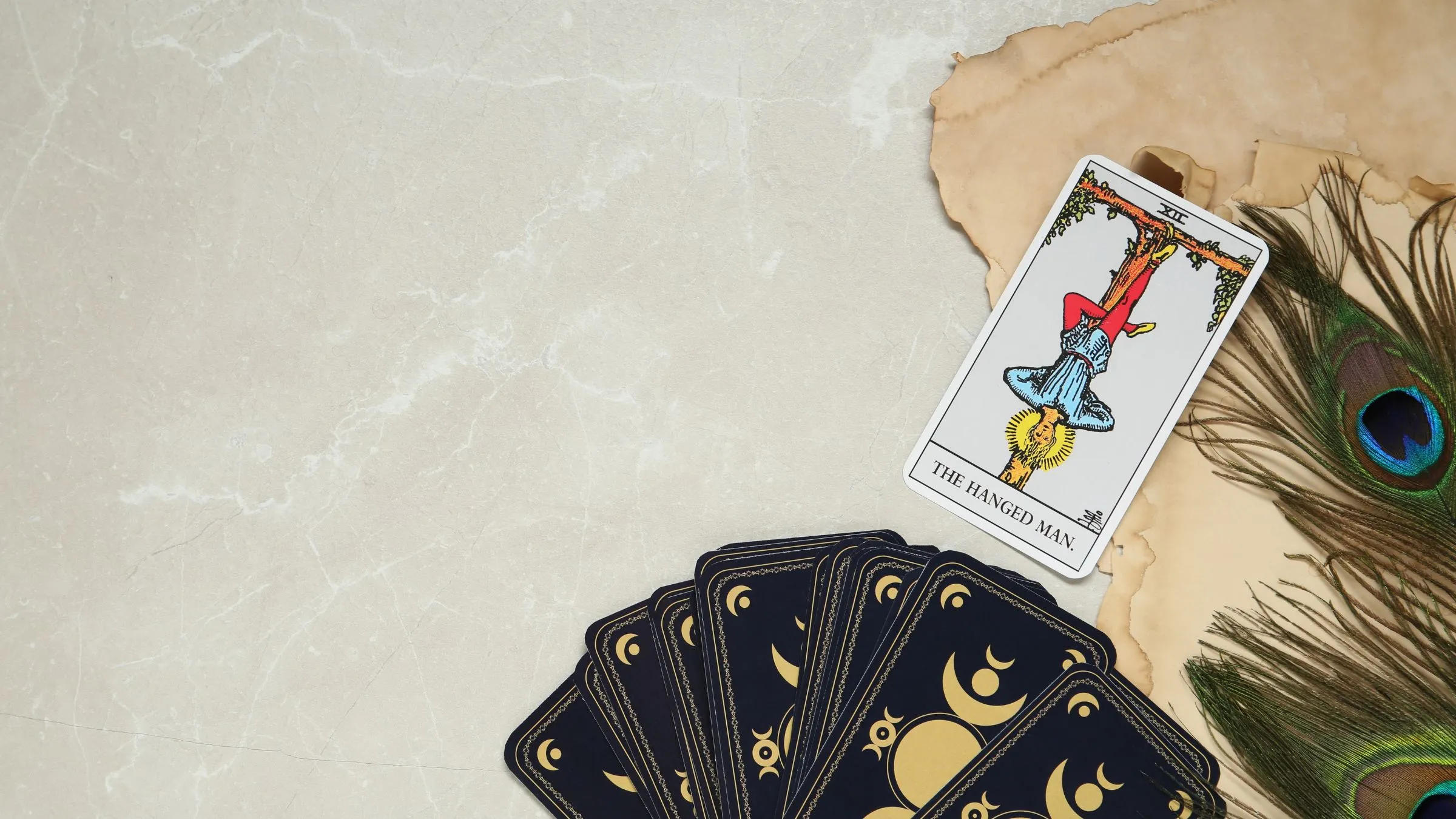
The Hanged Man in brief
In the Rider-Waite tradition, The Hanged Man stands for pause, surrender and a new way of seeing, a time when things are held in suspension. Modern readers often take it as a call to stop pushing, let go and look at a situation from another angle, while the reversed card points to stalling, delay or resistance to a pause that is needed.
Waite wrote that the figure suggests “life in suspension, but life and not death.” Biddy Tarot calls it the card of ultimate surrender.
The card’s picture
Waite wrote that the gallows from which the figure hangs forms a Tau cross, while the position of the legs forms a fylfot cross. There is a nimbus, a halo, about the head of “the seeming martyr.” Waite asked readers to notice three things: the tree of sacrifice is living wood with leaves on it, the face “expresses deep entrancement, not suffering,” and the figure as a whole suggests life held in suspension.
In his notes on older packs, Waite described the man suspended head downward, tied by a rope about one ankle, with his arms bound behind him and one leg crossed over the other. Waite wrote that the card “has been called falsely” a card of martyrdom, prudence or duty, and that in his own view it expresses one aspect of the relation between the Divine and the Universe.
Modern guides fill in the colors. Biddy Tarot reads his calm, serene face as a sign that he hangs by his own choice, and his halo as new insight and awareness. Biddy Tarot and Labyrinthos both read his red trousers as human passion and the physical body. Labyrinthos reads his blue shirt as calm emotions and the yellow of his shoes, hair and halo as intellect.
Upright meaning
Waite’s divinatory list for the upright card is wisdom, circumspection, discernment, trials, sacrifice, intuition, divination and prophecy. Waite added that one who understands the card may receive intimations of “a great awakening that is possible.”
Labyrinthos reads the upright Hanged Man as a sacrifice made in order to move forward, a step back taken to rethink the path ahead. Labyrinthos also reads it as a need to suspend action and a period of indecision, and as a reminder that refraining from action can sometimes bring as much as acting.
Biddy Tarot reads the card as a reminder that sometimes everything has to be put on hold before the next step. Biddy Tarot also reads it as a call to release old mental models and habits so that the world can be seen from a new perspective. Biddy Tarot adds that when projects come to a sudden halt, the card frames the pause as a chance to reassess rather than push harder.
Reversed meaning
Waite listed the reversed Hanged Man as selfishness, the crowd and the body politic.
Labyrinthos reads the reversed card as a period of sacrificing a great deal of time while getting little in return, with things at a standstill.
Biddy Tarot reads the reversed Hanged Man as knowing a pause is needed but resisting it, keeping busy to avoid the real issue. Biddy Tarot also reads it as being kept on hold by other people or circumstances, and as a prompt to let go of how things “should” be. Biddy Tarot adds that after a long pause the reversed card can be a positive sign of moving forward with a new perspective, and that it can also show a decision being stalled.
The Hanged Man in love
In love, Labyrinthos reads the upright Hanged Man as a sign that things cannot be rushed, for singles and couples alike. Labyrinthos also reads it as a time to see how one’s perspective changes when alone, and as sacrifice playing a part in a relationship.
Reversed, Labyrinthos reads the card as the end of a period of waiting, with renewed energy for change in one’s love life. Labyrinthos also cautions under the reversed card against needless sacrifices for love. Biddy Tarot reads the reversed card, where a relationship is on hold, as being content to wait only up to a point.
The Hanged Man in career
For work, Labyrinthos reads the upright Hanged Man as a feeling of waiting or uncertainty, with projects paused and the next move still being weighed. Labyrinthos also reads it as a lesson that some decisions cannot be forced, and sometimes as a step back that is really a realignment toward more fulfilling work.
Reversed, Labyrinthos reads the card as career sacrifices that have not yet paid off. Labyrinthos also reads it as stalling and procrastination that leave a person feeling stuck.
The Hanged Man and money
Labyrinthos reads the upright Hanged Man in money questions as a need for a change in perspective, where a pause may reveal a new way of looking at a stressful situation.
Reversed, Labyrinthos reads the card as indecision about a major purchase, or as a sense of wasted sacrifice to be taken as a lesson.
The Hanged Man as feelings
As feelings, Labyrinthos reads the upright Hanged Man as contemplation and surrender: someone taking time with their emotions and viewing things from different angles. Labyrinthos also reads it as one’s own sense of being suspended between action and reflection.
Reversed, Labyrinthos reads frustration and impatience, with someone feeling stuck in their emotions. Labyrinthos also reads the reversed card as one’s own wish for change held back by circumstance or indecision.
Questions to reflect on
- What would change if this situation were seen from another angle?
- Is there something being forced that would do better with patience?
- What old habit or belief is ready to be released?
- Is a pause being resisted by keeping busy?