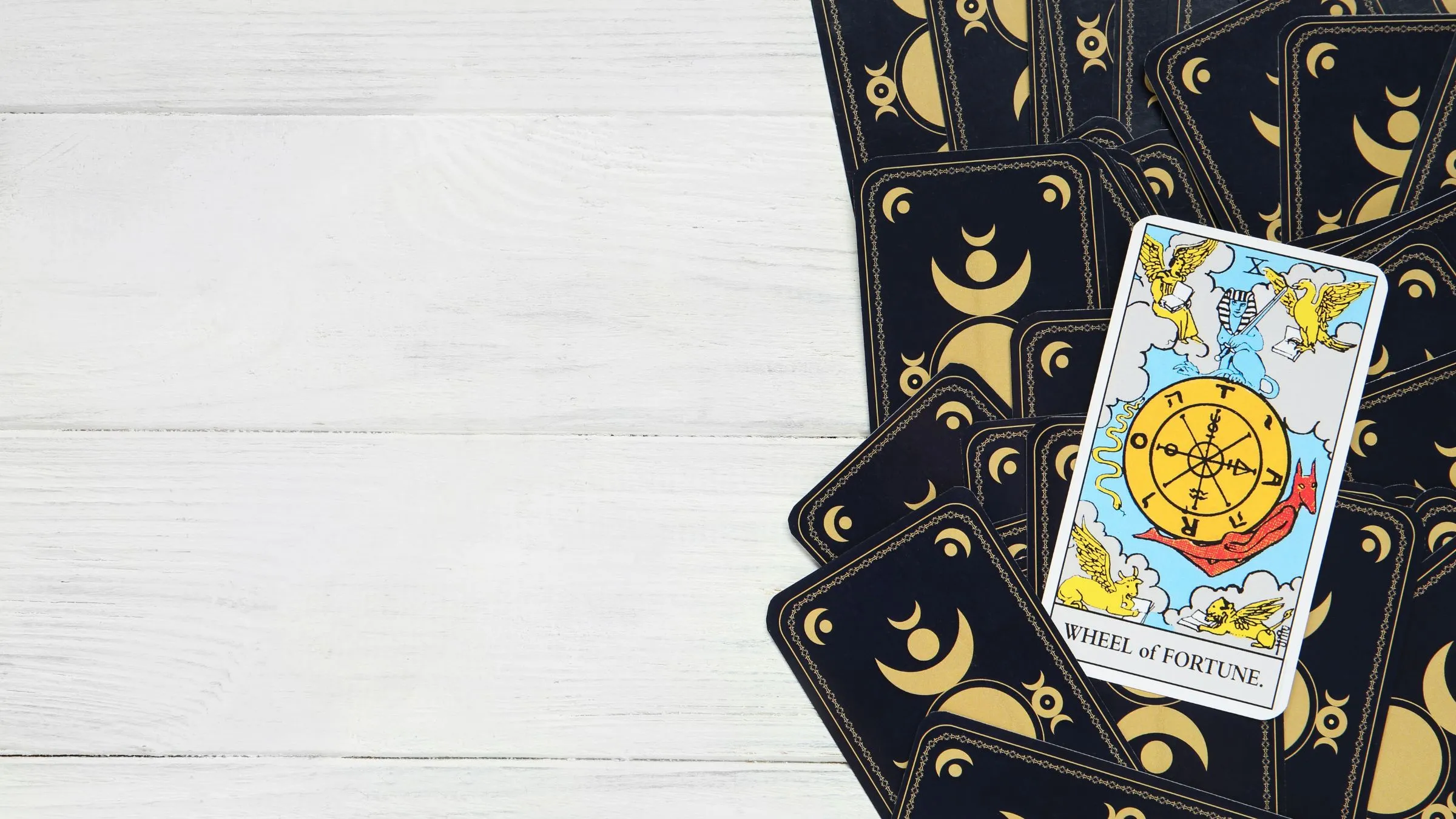
Wheel of Fortune in brief
In the Rider-Waite tradition, the Wheel of Fortune stands for cycles, change and turning points, the sense that life is always in motion. Modern readers often take it as a reminder that neither good times nor hard times stay fixed, while the reversed card points to unwelcome change, resistance to change or a run of bad luck.
Waite read the card as “the perpetual motion of a fluidic universe” and “the flux of human life.” Waite also wrote that behind the symbol lies “the denial of chance,” the idea that providence works through the turning.
The card’s picture
Waite wrote that he followed the reconstruction of the French occultist Eliphas Levi for this card. The four Living Creatures of Ezekiel’s vision sit in the corners, and the wheel itself carries the letters of TARO read as ROTA, the Latin word for wheel, alternating with the letters of the Divine Name. Waite read the sphinx on the wheel as “the equilibrium” within all that movement, and he showed the Egyptian figure Typhon in serpent form.
In his notes on older packs, Waite described the same reconstruction in other words: Hermanubis rising with the wheel, a sphinx at the top and Typhon on the descending side. Waite added that a sphinx placed on a pedestal above the wheel spoils the idea of “stability amidst movement.”
Modern guides read the details closely. Biddy Tarot reads the four winged creatures as the four fixed signs of the zodiac, the angel as Aquarius, the eagle as Scorpio, the lion as Leo and the bull as Taurus, and their wings as stability amid change. Biddy Tarot reads the descending snake as the cycle of change and the shedding of the old, and the sphinx on top as knowledge and strength. Labyrinthos reads the rising and falling figures as a cycle in which, as one comes up, the other goes down.
Upright meaning
Waite’s divinatory list for the upright Wheel is destiny, fortune, success, elevation, luck and felicity. Waite wrote that the findings of “common fortune-telling” are better for this card than many occult explanations of it.
Labyrinthos reads the upright Wheel as the turning of good and bad times, a cycle that no one can fully control. Labyrinthos also reads it as greater forces at work, like the changing seasons, and as a reminder that wherever the wheel lands, the position may not last long.
Biddy Tarot reads the Wheel as a reminder that life is in constant change, and as encouragement to cherish the good moments while they are here. Biddy Tarot also reads it as the wheel of karma, “what goes around comes around,” and as a critical turning point where unexpected openings appear. Biddy Tarot adds that for anyone who likes control and stability, the card can come as a shock, since it shows factors outside one’s control at work.
Reversed meaning
Waite listed the reversed Wheel as increase, abundance and superfluity.
Labyrinthos reads the reversed card as a time when luck has not been on one’s side, due to outside influences beyond control. Labyrinthos also reads it as a lesson in letting go of the illusion of control, with acceptance and self-forgiveness as the way forward.
Biddy Tarot reads the reversed Wheel as unexpected change and a choice between waiting passively and acting to improve the situation. Biddy Tarot also reads it as resistance to change, and on the positive side as breaking a negative cycle that has repeated in one’s life.
Wheel of Fortune in love
In love, Labyrinthos reads the upright Wheel as great changes in a relationship, perhaps unexpected, that call for adjustments. Labyrinthos also reads the card as a test of commitment, in which learning to ride life’s ups and downs together can bring a couple closer.
Reversed, Labyrinthos reads the card as an outside factor affecting a relationship, to be met with patience rather than control. Labyrinthos also reads it as a pause in romantic life while other demands take over, and as a call for couples to communicate openly as a team.
Wheel of Fortune in career
For work, Labyrinthos reads the upright Wheel as big career changes and a good moment for a switch, with attention to openings as they arise. Labyrinthos also reads difficult changes under this card as chances to grow skills, and frames adaptability as the key.
Reversed, Labyrinthos reads the card as fast change that is hard to keep up with, and as clinging to a past solution instead of adapting. Labyrinthos frames the reversed card as a prompt to stay flexible and find one’s center.
Wheel of Fortune and money
Labyrinthos reads the upright Wheel in money questions as change in one’s material situation, with flexibility as the theme.
Reversed, Labyrinthos reads the card as unexpected and unwelcome changes, and links it to a wish to feel prepared for what comes next.
Wheel of Fortune as feelings
As feelings, Labyrinthos reads the upright Wheel as emotions that are shifting and evolving, with a sense that fate has brought two paths together. Labyrinthos also reads it as one’s own mix of hope and nerves about change.
Reversed, Labyrinthos reads uncertainty and instability, with someone frustrated by circumstances that seem beyond their control. Labyrinthos also reads the reversed card as one’s own sense of being stuck in a cycle, and frames it as part of life’s ebb and flow.
Questions to reflect on
- Which part of life feels as if it is in a season of change?
- What is within control here, and what is not?
- Is there a repeating pattern that is ready to be broken?
- What good moment deserves to be enjoyed while it lasts?